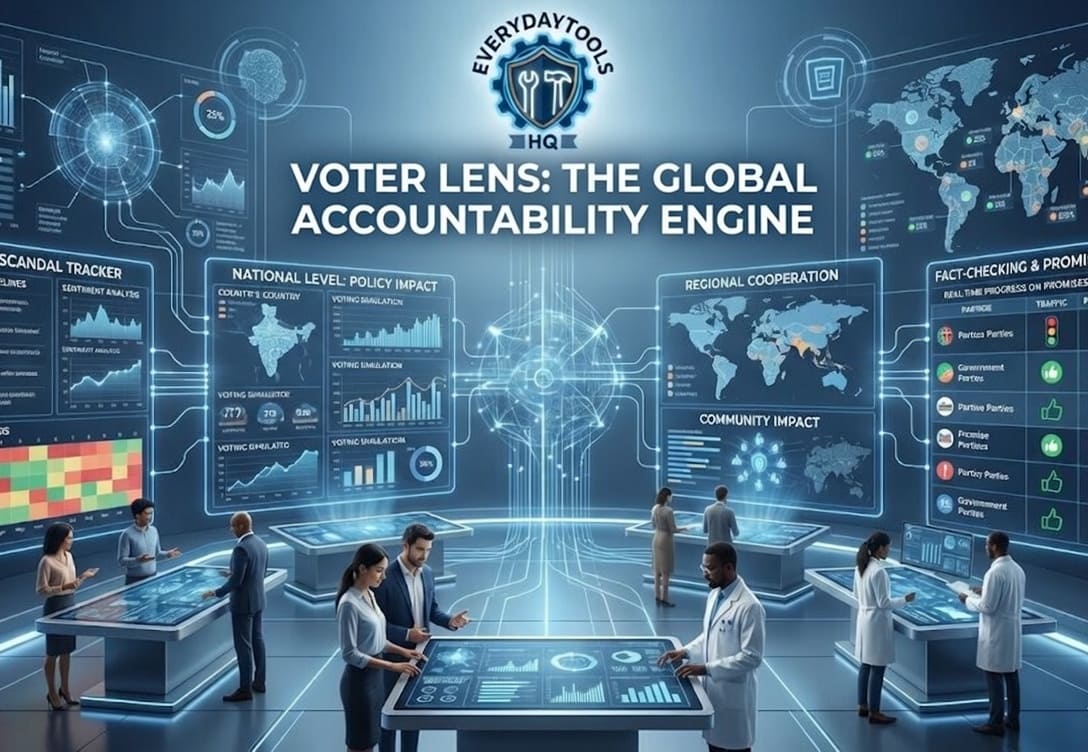
VoterLens: Remove the Veil
A full diagnostic dossier on any political party — real promises vs. reality, whether the numbers add up, what history warns us, and exactly how it hits your household. Live data. Zero spin.
📚 Best Sellers in Politics & Current Affairs

🔬 How VoterLens Works — Full Transparency
The Core Principle: Forensic Auditor, Not Opinion Writer
VoterLens works like a forensic accountant and a historical scholar working together. It has no political opinion. It applies identical methodology to every party: measure promises against verified live data, test feasibility against real national budgets, and match rhetoric against named historical precedents. The goal is always the same — what do the numbers and the record actually say?
⚖️ How Neutrality Is Enforced
Every party receives identical methodology regardless of political position. A left-wing party's spending promises are stress-tested against the same fiscal data as a right-wing party's tax cuts. The traffic light scoring (🟢🟡🔴) uses objective criteria: does the arithmetic work, does the history support it, does the independent evidence back it up. No party, ideology or political position is given a different standard. When data is missing or unverifiable, VoterLens says so explicitly rather than filling gaps with assumptions.
📡 The Data Stack (All Official, All Free)
World Bank Open Data API — verified GDP, unemployment, inflation, government debt, healthcare spend, education spend, inequality (GINI), poverty rates and CO₂. Used as a hard ceiling to test whether policies are mathematically possible given the country's actual fiscal position.
WHO Global Health Observatory — Universal Health Coverage index scores. Wikidata SPARQL — live party list, ideology, leadership and seats per country, updated in near-real-time. Wikipedia REST API — party history in the user's language. Curated Knowledge Base — for major parties (UK, US, Australia, Ireland, Germany, Italy, France, Canada, India, Spain, South Africa, Brazil, New Zealand): real manifesto commitments, IFS/OBR/Deutsche Bank analyses, verified fact-checks, documented controversies with cited sources, and promise vs delivery records.
🏗️ What Each Dossier Section Measures
Key Campaign Pillars — the manifesto promises for the next election, explained plainly and tested against the data. Accountability Pulse — four scores (fact-check, historical risk, budget feasibility, civil rights) based on documented evidence, not opinion. Demographic Overview — what their policies specifically mean for women, children, elderly, disabled people and minorities. Immigration Reality Check — the actual difference between illegal and legal migration, what migrants do economically, and what removal would mean in practice. Veil-Remover — for each topic: the slogan, the blueprint, the hidden price, feasibility against real GDP/debt data, income-bracket impacts, and named historical precedents. Country Status — 20-year governance record, metric trends over time, and cross-party priorities based on what the data says any responsible government should be working on.
🤖 The AI Power Boost
The base dossier renders from live data and the curated knowledge base with no AI required. The AI Boost at the bottom of the dossier lets you go deeper. Tick any AI you are already logged into — ChatGPT, Gemini, Claude, Grok, DeepSeek, Perplexity, Copilot or Mistral. Choose National mode for the full 12-section forensic prompt or Local/Regional mode for a council/state-level analysis of your specific town or postcode. VoterLens builds a structured prompt with all the real economic data already embedded — one paste gives you the deepest possible analysis using your full account tier.
⚖️ Important Disclaimer — Please Read
VoterLens is an independent informational tool only. It is not affiliated with, endorsed by, or connected to any political party, government body, media organisation, or campaign group.
Sources & Accuracy: Information in VoterLens comes from multiple sources including: public APIs (World Bank, WHO, Wikidata, Wikipedia), curated editorial content based on publicly available reporting, and AI-assisted analysis. All sources are cited where provided. However, VoterLens cannot guarantee the completeness, currency or accuracy of all information. Data may be outdated, incomplete or subject to interpretation. Some analysis — particularly pulse scores for parties without a full curated profile — is estimated based on spectrum position and available data, and is clearly labelled as such.
Controversies & Documented Record: Information in the Controversies section is drawn from publicly reported events covered by established news organisations and official sources (parliamentary records, court documents, regulatory findings). All entries include a cited source. VoterLens does not make original allegations — it summarises what has already been publicly reported and officially documented. Where a matter is alleged rather than proven, this is noted. The absence of a controversy entry does not mean a party has no controversies — it may simply mean that party does not yet have a full curated profile in VoterLens.
Not Political Advice: VoterLens does not tell you how to vote. It provides structured, evidence-based information to help you make your own informed decision. Always verify information using primary and independent sources before making any voting decision. Different people may interpret the same facts differently, and political choices involve values that data alone cannot resolve.
No Liability: VoterLens and its operators accept no responsibility for decisions made based on this tool. Use of this tool constitutes acceptance that it is provided for informational purposes only, on an as-is basis, with no warranty of accuracy or completeness. Information is drawn from publicly available sources and is provided as-is.