
The Cat Toolkit — everything you need for your cat or kitten
🐾 Cat Age 🥫 Food Safety 🧠 Behavior Decoder ⚖️ Feeding Guide ✅ Kitten Checklist 💛 Cat Names 😸 Why Cats Purr ❤️ Health Signs

🐾 Cat Age Calculator

How old is your cat in human years? Unlike the "multiply by 7" myth for dogs, cat ageing has its own unique pattern — very rapid in the first two years, then steadier. Enter your cat's age for an accurate conversion.
0 – 30 years
0 – 11 months
Your cat is approximately
human years old
🍼
Kitten
0–6 months → ~0–10 human yrs
Explosive growth. A 6-month-old kitten is roughly equivalent to a 10-year-old child — full of curiosity and energy.
🐱
Junior
6 months–2 yrs → ~10–24 human yrs
Sexual maturity, full growth. Cats reach social maturity around 18 months — equivalent to a young adult in their early 20s.
😸
Prime & Adult
3–6 yrs → ~28–40 human yrs
Peak physical condition. Confident, settled, and at their most athletic. Each cat year ≈ 4 human years at this stage.
🧓
Mature & Senior
7–14 yrs → ~44–72 human yrs
Senior cats need more vet visits and joint support. A 10-year-old cat is roughly 56 in human years. Cats often live 15–20 years.
Cat Essentials — everything for your kitten and cat
🛒 Recommended for Cat Owners

Cat Essentials — Everything Your Cat Needs

From bowls to scratching posts, carriers to grooming kits — everything on our kitten checklist, in one convenient shop.

Shop on Amazon →
Affiliate Disclosure: we may earn a commission if you purchase through our links at no extra cost to you.

🥫 Cat Food Safety Checker

Can cats eat that? Search any food to instantly find out if it's safe, risky, or toxic for your cat.

🔍

Quick reference: Always toxic — chocolate 🍫, onions/garlic 🧄, grapes/raisins 🍇, xylitol, alcohol, raw dough. Generally safe in small amounts — plain cooked chicken 🍗, cooked fish, plain rice. Always ask your vet before introducing new foods.

🧠 Cat Behavior Decoder

Why is my cat doing that? Select a behavior to get the real explanation — plus what (if anything) you should do about it.

⚖️ How Much Should I Feed My Cat?

Enter your cat's details to get a personalised daily calorie target and feeding guide. Overfeeding is the #1 preventable cat health issue.

0.5 – 20 kg

Your Cat's Daily Feeding Guide

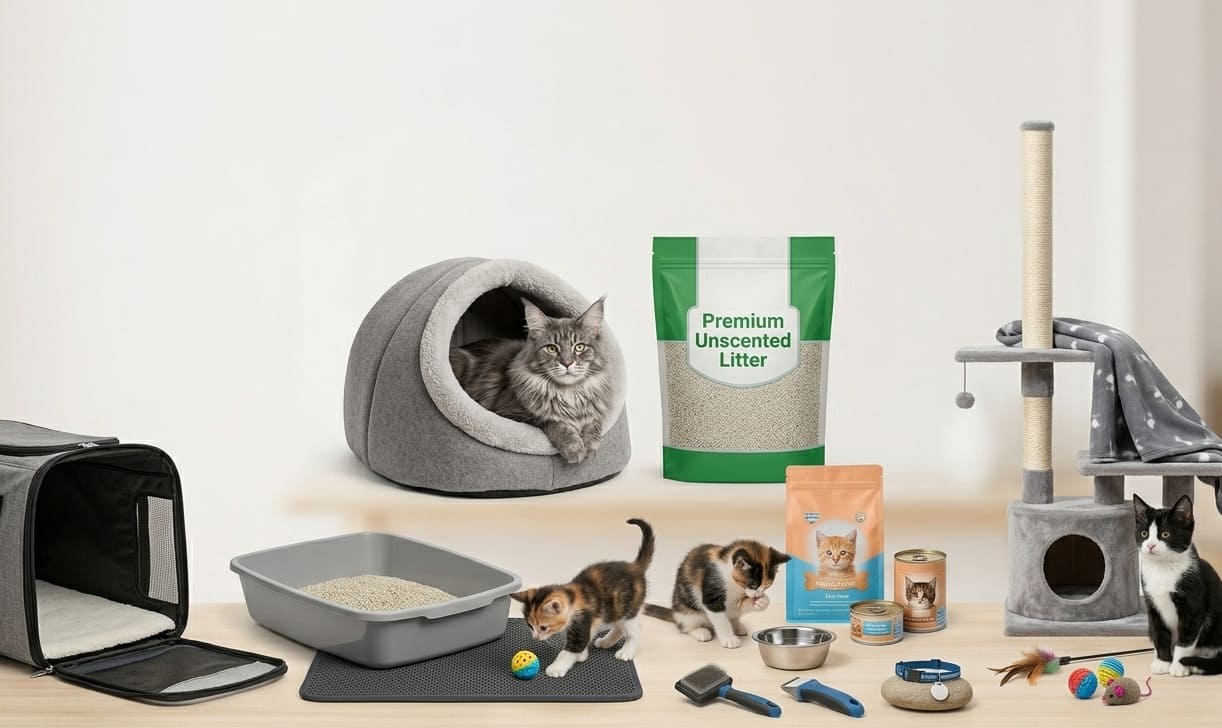
✅ New Kitten & Cat Checklist

Check off every essential — tap each item when you have it. Don't let your kitten come home unprepared!

0 / 20 items

🍽️ Feeding & Hydration

🚽 Litter & Hygiene

🛏️ Sleep & Comfort

🛡️ Safety & Travel

🎾 Grooming & Play

🛒 Shop Everything on This List on Amazon →

Affiliate link — we may earn a small commission at no cost to you.

💛 Cat Name Finder

Browse names by vibe — tap any name that catches your eye. Tap "Generate New Names" for fresh ideas.

😸 Why Does My Cat Purr?

Purring is one of the most misunderstood cat behaviours. Most people assume it always means happiness — but the reality is far more nuanced and fascinating.

🔬
The science: Cats purr by rapidly dilating and constricting their laryngeal muscles, which causes the glottis (the part of the larynx that surrounds the vocal cords) to open and close during both inhalation and exhalation — producing a frequency of 25–150 Hz. Remarkably, this frequency range has been shown in research to promote bone density, accelerate healing, and reduce pain in the cat itself. Purring may literally be therapeutic.
Purring = happy (contentment purr)
The most common reason. A slow, rhythmic, low-frequency purr during petting, kneading, or curling up beside you almost certainly means your cat is relaxed and content. Often accompanied by slow blinking and a relaxed tail.
Purring when stressed or in pain (self-soothing purr)
Cats also purr when they are anxious, injured, giving birth, or near death. It is thought to be a self-soothing mechanism — and the healing vibrations may also help with physical recovery. A cat purring at the vet is not necessarily happy; they may be trying to calm themselves.
The "solicitation purr" (when they want food)
Researchers at the University of Sussex identified a specific type of purr cats use to get what they want — particularly food. It embeds a subtle, higher-pitched cry (similar to a baby's cry) within the purr, which humans find harder to ignore. Many cat owners recognise this specific, slightly urgent purr.
Purring during grooming or social bonding
Cats purr during mutual grooming with other cats and during close contact with trusted humans. In this context it functions as a social bonding signal — equivalent to a human hum or sigh of comfort.
When should I be concerned about purring?
If your cat is purring but also showing signs of distress — hiding, loss of appetite, laboured breathing, vomiting, or unusual posture — the purring may be masking pain. A sudden change in purring pattern (especially a cat that has gone quiet) can also be a health signal. When in doubt, consult your vet.

❤️ Signs Your Cat May Be Unwell

Cats are famously stoic and often hide pain or illness. Knowing the early warning signs can make a significant difference to outcomes. Contact your vet if you notice any of the following.

🚨 Emergency signs — seek a vet immediately
Difficulty breathing or open-mouth breathing • Inability to urinate (especially in male cats — can be life-threatening within hours) • Pale, blue, or white gums • Collapse or unresponsiveness • Severe vomiting or diarrhoea with blood • Suspected poisoning (plants, food, chemicals) • Major trauma or injury.
Changes in eating or drinking habits
A sudden increase in thirst and urination can indicate diabetes or kidney disease. A sudden loss of appetite lasting more than 24-48 hours needs veterinary attention — cats can develop hepatic lipidosis (fatty liver disease) surprisingly quickly when they stop eating.
Changes in litter box habits
Straining, crying in the litter box, blood in urine or stool, or urinating outside the box can all indicate UTIs, kidney issues, or blockages. Male cats straining to urinate is a medical emergency — never wait it out.
Sudden behaviour changes
Hiding more than usual, aggression in a normally calm cat, or sudden clinginess can all be signs of pain or illness. Cats hide weakness instinctively — sudden withdrawal is often the first visible sign something is wrong.
Weight changes and coat condition
Weight loss despite eating well can indicate hyperthyroidism, diabetes, or intestinal disease. A greasy, dull, or unkempt coat can signal illness, obesity (cat can't reach to groom), dental pain, or arthritis. Older cats who stop grooming need a vet check.
Signs of pain or discomfort
Half-closed eyes, a hunched posture, reluctance to jump or be touched in certain areas, grinding teeth (bruxism), or an unusually tense abdomen may all indicate pain. Purring in a cat that seems otherwise unwell can also be a pain response — not contentment.
Vomiting — when to worry
Occasional vomiting of hairballs is normal. However: vomiting more than once or twice per week, vomiting blood or foreign objects, vomiting with lethargy or loss of appetite, or projectile vomiting all warrant a vet visit. Never assume vomiting is always "just" hairballs.
Dental and mouth problems
Bad breath, drooling, pawing at the mouth, or dropping food can indicate dental disease — which affects around 70% of cats over 3 years of age. Dental disease is painful and can contribute to kidney and heart disease. Annual dental checks are strongly recommended.

🛋️ How to Stop Your Cat Scratching Furniture

Scratching is a completely natural, necessary behaviour for cats — it maintains claw health, stretches muscles, and marks territory. You cannot stop a cat from scratching. You can redirect it.

Why cats scratch (and why you can't just "stop" it)
Cats scratch to shed the outer layer of their claws, stretch their back and shoulder muscles, and to leave visible and scent marks in their territory. It is as instinctive as eating. Punishment does not work — cats lack the ability to connect a punishment to a prior action unless caught in the very act.
Provide better alternatives nearby
Place a tall, stable scratching post directly next to the furniture they're targeting. Cats prefer posts that are at least as tall as their full stretch length (30+ inches). Sisal rope is the most popular material. If your cat ignores vertical posts, try a horizontal scratcher. Many cats have a preference.
Make the furniture less appealing
Double-sided sticky tape (like Sticky Paws) on the target area works well — cats dislike the texture. You can also try aluminium foil or citrus spray (most cats dislike citrus). Remove the deterrent once the scratching post habit is established.
Nail caps and regular trimming
Soft Paws nail caps glued over the claws make scratching harmless to furniture. They last 4–6 weeks. Alternatively, regular nail trimming every 2–3 weeks reduces damage significantly. Ask your vet to show you the correct technique if you're new to it.
Reward the right behaviour
Every time you see your cat use the scratching post, immediately reward them with a treat, praise, or play. Positive reinforcement is far more effective than punishment. Rub catnip into the post to encourage interest.